
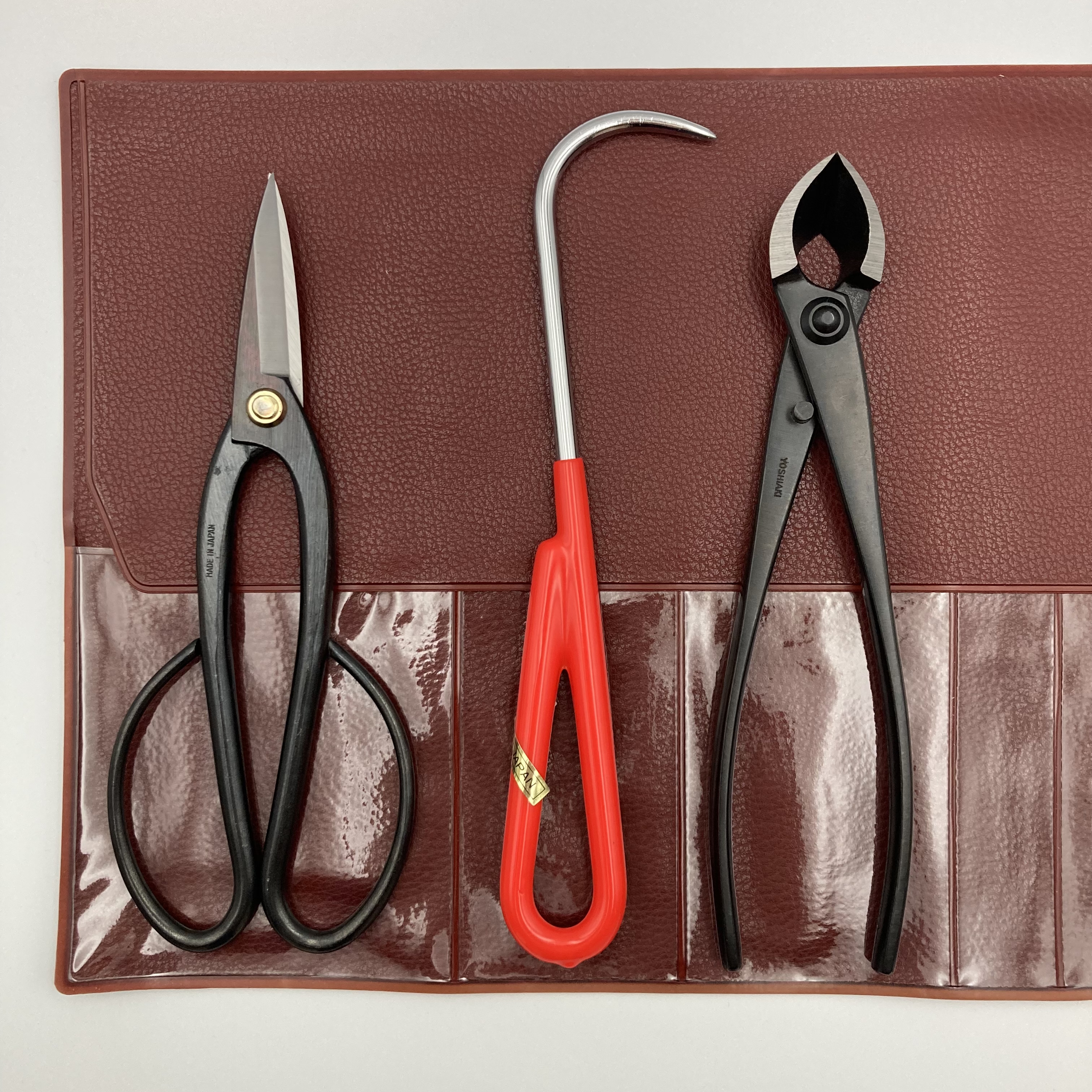
One of the most common questions beginners ask is: what tools do I actually need? Walk into any bonsai supply store — or browse online — and you’ll find dozens of specialized cutters, hooks, pliers, and scoops. It can feel overwhelming. The good news is that you don’t need all of it to start. Most bonsai work, especially in the early stages, comes down to three tools. Get those right and you’re set.
The Three Tools Every Beginner Needs
If you’re just starting out, these are the only tools you truly need:
- Bonsai shears — for trimming foliage, removing shoots, and light branch work
- Concave cutter — for removing branches cleanly at the trunk
- Root hook — for untangling root masses during repotting
That’s it. These three tools cover the vast majority of what you’ll do in a typical bonsai session — pruning, structural work, and repotting. Everything else is specialized and becomes useful as your practice deepens.
Why Shears Come First
Bonsai shears are the tool you’ll reach for most often. They handle foliage trimming, removing unwanted shoots, cutting back new growth, and light branch removal. A quality pair of shears should feel balanced in your hand, open and close smoothly, and hold an edge through heavy use.
Not all shears are created equal. The geometry of the blade matters — bonsai shears are designed with a narrow profile specifically for working inside the canopy of a tree, where a wider blade would damage surrounding growth. Japanese shears, in particular, are made from carbon steel and hand-finished to a degree of precision that generic alternatives simply don’t match.
For most people, an 8″ shear is the right starting point. It’s long enough for reach, balanced for most hand sizes, and versatile across species. If you work with pines or do a lot of interior canopy work, an 8.25″ shear with a longer, narrower profile handles those situations better.
Why You Need a Concave Cutter
This one surprises beginners. Why not just use the shears to remove a branch?
The answer is healing. When you remove a branch with shears, you’re left with a flat cut that heals slowly and often leaves a raised scar on the trunk. A concave cutter is shaped differently — its curved cutting head removes the branch while leaving a concave hollow in the trunk. That hollow heals faster and calluses over flush, producing a much cleaner result over time.
If you care about the long-term appearance of your tree — and in bonsai, you do — a concave cutter is non-negotiable from the start. Using one from the beginning builds good habits and protects your trees. Pair it with cut paste after each use to seal the wound and you’ll see noticeably cleaner healing.
The Root Hook: Essential at Repotting Time
You won’t use a root hook every session, but when repotting comes around — typically every one to three years depending on species and pot size — it becomes indispensable. Roots in a bonsai pot grow densely and mat together over time. Trying to separate them with your fingers risks tearing fine feeder roots, which slows recovery significantly.
A root hook lets you tease apart root masses carefully and methodically, preserving the feeder roots that do the real work of nutrient uptake. It’s a simple tool, but it makes a real difference in how quickly a tree bounces back after repotting.
Should You Buy Tools Individually or as a Set?
For beginners, a tool set is almost always the better choice. You get the three core tools together — often at a better price than buying individually — plus a case to keep everything organized. It also removes the decision fatigue of piecing together a kit from scratch.
The Core Bonsai Tool Set from Morgan’s Bonsai includes exactly the three tools covered here — shears, concave cutter, and root hook — along with a 5-slot vinyl tool case, all made in Japan by Yoshiaki. It’s designed specifically for this stage of practice: everything you need, nothing you don’t.
As your skills grow, you can add to your kit thoughtfully. Jin pliers open up wire work and deadwood techniques. A spherical knob cutter handles the aftermath of branch removal. Tweezers are invaluable for detail work and needle plucking. But those are additions for later — not day one.
A Note on Tool Quality
Bonsai tools are an investment, and the gap between quality Japanese tools and generic alternatives is significant. It’s not just about prestige — it’s about how the tool performs over years of use. A poorly made shear won’t hold an edge, will crush rather than cut, and may damage your trees. A quality shear, maintained with a few drops of camellia oil after each session, will last decades.
Buy good tools once. It’s one of the best decisions you can make early in your bonsai practice.
Where to Start
If you’re ready to put together your first kit, browse the tool sets at Morgan’s Bonsai. Every tool is made in Japan and built for serious practice — whether you’re just starting out or adding to a collection you’ve had for years.
Leave a Reply